Dental bridges in Budapest
A dental bridge replaces one or more missing teeth with a fixed row of crowns: the teeth next to the gap carry a false tooth between them. In Budapest a 3–5 unit bridge on your own teeth is usually made in one visit of 4–5 days, and you receive a written quote that lists every unit before you travel. The trade-off is honest and simple: the neighbouring teeth have to be filed down, so a bridge makes most sense when those teeth already need crowns, or when an implant is not an option.
A dental bridge replaces missing teeth with a fixed row of crowns, carried by the teeth next to the gap or by implants. In Budapest a bridge on natural teeth takes one visit of 4–5 days; on implants it needs two visits with 3–6 months of healing. Bridges are quoted per unit and have a 3-year guarantee.


 BeforeAfter
A bridge is a fixed, non-removable replacement for missing teeth. It has two kinds of parts:
Each crown and each false tooth counts as one unit. That is why bridges are described as 3-unit, 4-unit and so on, and why your quote lists every unit rather than one figure per bridge.
A bridge restores chewing, closes the gap and stops the neighbouring teeth from leaning into the space. What it does not do is replace the root, so bone loss can continue under the false tooth.
For a bridge on natural teeth, the teeth next to the gap must be strong and healthy enough to act as pillars. Your panoramic X-ray shows whether they are.
| Key fact | Answer |
|---|---|
| One missing tooth | 3-unit bridge: 2 crowns and 1 false tooth |
| Materials | Porcelain fused to metal, zirconium or full porcelain |
| On natural teeth | One visit of 4–5 days |
| On implants | Two visits, 3–6 months of healing in between |
| Lifespan | Typically 10–15 years on natural teeth |
| Guarantee | 3 years on the bridge, kept valid by annual check-ups |
| Free of charge | The consultation, X-rays, and local anaesthesia for the pillar teeth |
The number of units depends on how many teeth are missing in a row. On natural teeth, the rule is two pillars, one at each end of the gap:
| Missing teeth in a row | Typical bridge | Pillars |
|---|---|---|
| 1 tooth | 3-unit bridge (2 crowns + 1 false tooth) | 2 |
| 2 teeth | 4-unit bridge | 2 |
| 3 teeth | 5-unit bridge | 2 |
| Longer gaps | 6 units or more | An extra pillar tooth is needed in the middle of the gap |
If there is no healthy tooth in the middle of a long gap, a bridge on natural teeth is not possible, and implants become the way to support it.

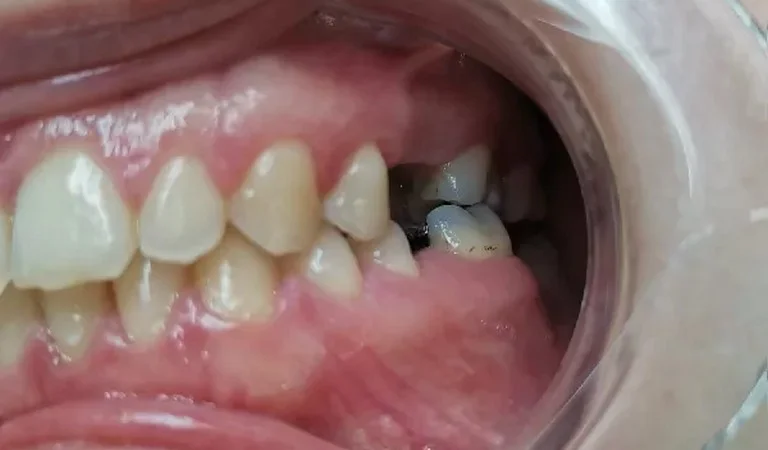 BeforeAfter
The most common type. Natural pillar teeth at both ends of the gap are filed down and crowned, and the false tooth or teeth sit between them. Quick, fixed and predictable, as long as the pillar teeth are strong.
Supported on only one side, by one or more teeth. It is used when there is a tooth on only one side of the gap, and it is applied for back teeth.
The bridge is fixed to dental implants instead of natural teeth. No healthy teeth are filed down, and longer gaps can be bridged. It needs two visits, with healing time in between.
A metal or porcelain framework is bonded to the back of the neighbouring teeth, so they need little alteration. It is used for front teeth, but it is not a stable solution: it is mainly cosmetic and often needs replacing within 1–4 years.
One rule: a bridge is supported either by natural teeth or by implants, never by a mix of both, because implants do not move in the bone and natural teeth do.
At the far end of the scale, a complete bridge for a whole arch can be fixed on four or six implants. That is All-on-4 or All-on-6, covered in full mouth dental implants and fixed dentures.
A bridge is a row of crowns joined together, so the materials are the same as for crowns. The choice mainly depends on where the gap is:
Metal frame, porcelain surface. The most economical option, often recommended for molar gaps. It looks less natural than zirconium, a grey line can appear at the gum over time, and the porcelain can chip in people who grind.
Metal-free, biocompatible and very strong. Recommended for the front, where colour and shape are matched to your own teeth. Also an option for molars, and hard enough for longer bridges.
The most natural-looking material, but also the most delicate. Our dentists generally use it for single crowns rather than bridges. If you are considering it, ask whether it suits your gap.
A common combination is zirconium at the front and PFM for the molars. For the material question in depth, read zirconia vs porcelain fused to metal crowns, and for single crowns see dental crowns in Hungary.
Bridges are quoted per unit. A 3-unit bridge that replaces one missing tooth has three units: the two supporting crowns and the false tooth between them. Your quote lists every unit separately. The cost depends on:
You receive a written, itemised quote before you travel, so you know the cost before you book a flight. You pay nothing for the consultation, the X-rays or the local anaesthesia.
Besides treatment, plan for flights and accommodation. With one small bridge, travel takes a bigger share of the saving; with several units the trip pays off more clearly. More in dental travel to Budapest.

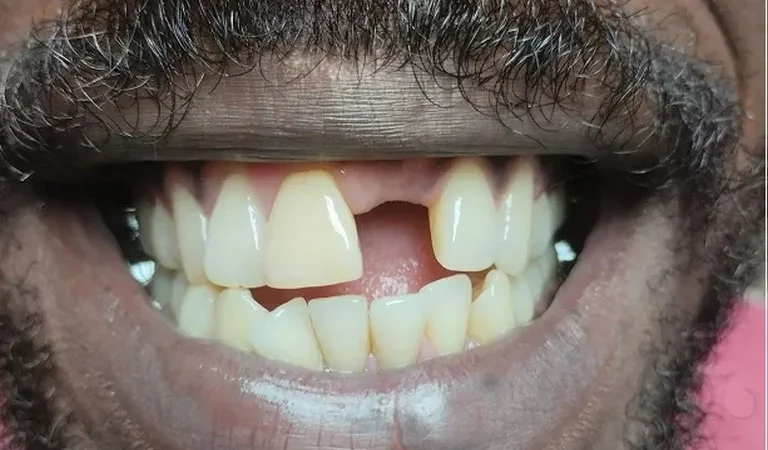 BeforeAfter
The short answer: if the teeth next to the gap are healthy, an implant is usually the better long-term choice. If those teeth are already damaged, or an implant is not advised, a bridge is often the right one. Here is a quick summary; the full comparison is in differences between dental bridges and implants.
The cost of filing down. To support a traditional bridge, the adjacent teeth must be significantly reshaped, even if they are perfectly healthy. This involves permanently removing a substantial amount of natural tooth structure to create space for the crowns supporting the bridge.
The exact amount depends on the tooth position and the type of restoration, but in some cases, a considerable proportion of the original tooth structure must be removed.
Once removed, natural tooth enamel and dentine do not grow back. This is an irreversible procedure, and the prepared teeth may also become more vulnerable to sensitivity, decay or the need for root canal treatment.
This is one of the main reasons why, whenever clinically suitable, we prefer dental implants over bridges supported by otherwise healthy teeth.
Cleaning. Food can collect under the false tooth. If it is not cleaned properly, it can lead to bad breath and decay on the pillar teeth.
Implants have their own costs: surgery, 3–6 months of healing and two trips. More in dental implants in Hungary.
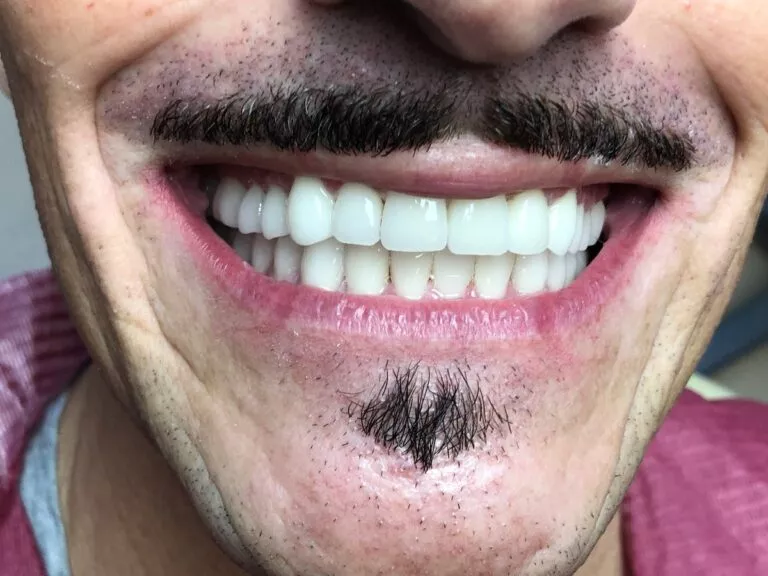
Molars take most of the chewing load. A PFM bridge is the most likely recommendation for a molar gap: it handles chewing pressure well, and its slightly less natural look matters less at the back. Zirconium is also used for molars if you want a metal-free mouth.
If there is a tooth on only one side of the gap, a cantilever bridge can be used in the back of the mouth. If the neighbouring teeth are not strong enough to act as pillars, an implant or an implant-supported bridge is the fixed alternative. For that route, see dental implants for molars.
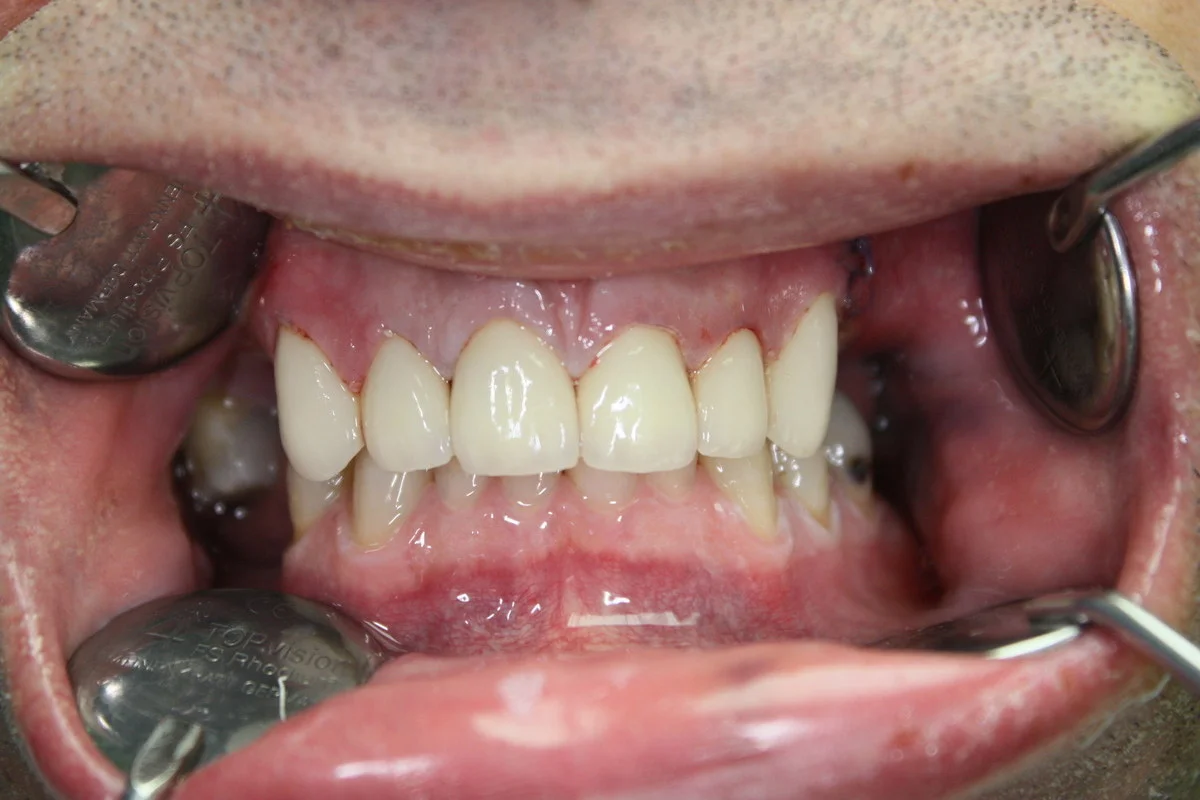
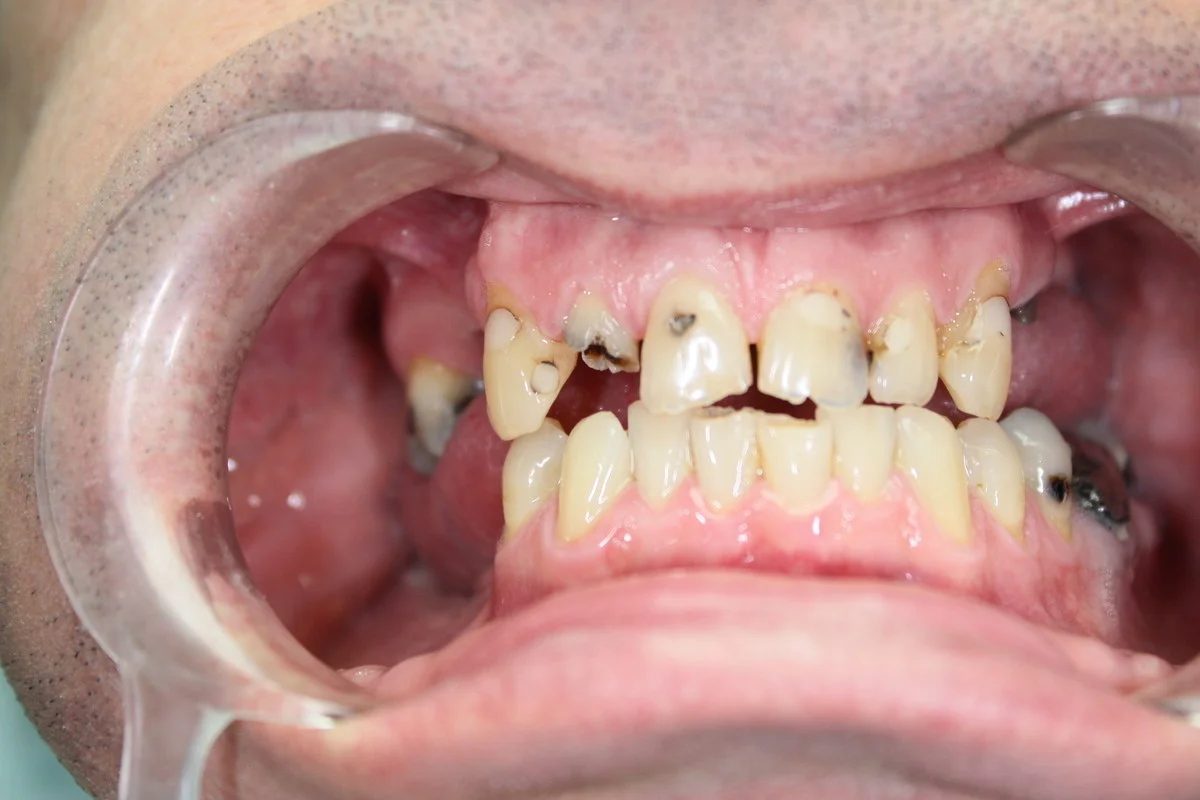 BeforeAfter
One of our patients had no molars and could not have implants because there was not enough bone. The solution was a bridge of zirconium crowns across the gap. It was only possible because the teeth at both ends of the gap were stable enough to act as pillars. The result is aesthetically pleasing, and her chewing ability is restored.
Other patients have combined bridges with implants. From our testimonials: the Danards received a full ceramic bridge on implants, and Mr. Mingault 11 implants and a 12-unit bridge for the top and bottom jaw. More results in zirconium crowns before and after.

 BeforeAfter
One visit of 4–5 days. Bridges of 3–6 units are normally prepared in 5 working days, because the dental lab makes them while you are here.
For a complete smile makeover or a full-arch reconstruction of 16–20 units, plan for 8–10 working days.
Two visits. The first takes 2–3 days for implant placement. After 3–6 months of healing you return for 4–5 working days to receive the final bridge.
Between the two implant visits you can wear a temporary partial denture, so you are not left with a gap. For more detail on visit lengths across treatments, read how long dental treatment lasts in Hungary.
A bridge on natural teeth normally takes 5 days. This is the typical schedule:
A bridge on natural teeth typically needs replacing every 10–15 years, and in less favourable cases it can be as short as 5 years. Plaque collects around a bridge more easily than around single teeth, and decay on the pillar teeth is the most common reason a bridge has to be replaced early.
On implants, the bridge on top also needs replacing every 10–15 years, but the implants themselves can last for decades, and no natural teeth are involved.
Crowns and bridges come with a 3-year guarantee. On implant-supported bridges, the implant itself (the product) has a lifetime guarantee. The guarantee is provided by the clinic, not by the individual dentist, and covers technical errors, such as a problem with the materials or the lab work. It does not cover new decay or damage from inadequate oral care, and temporary solutions are not covered.
The condition is attending annual check-ups and dental hygiene treatment. Guarantee treatment in Budapest is free of charge. Full conditions are in your quote and on guarantees of dental care in Hungary.
When you compare clinics for dental bridges in Hungary, look past the unit price and ask:
ISO certified German dental materials, listed in your quote.
3 years on crowns and bridges, provided by the clinic and covering technical errors. To keep it, attend annual check-ups.
If your bite or the bridge feels wrong after you fly home, let us know quickly and send photos if asked. The dentist then judges what your bridge needs.
Bridges are quoted per unit. The cost depends on the number of units, the material and whether the bridge sits on natural teeth or implants. From your panoramic X-ray you get a written quote, itemised per unit, before you travel.
Three: two crowns on the teeth at both ends of the gap and one false tooth in between. Two missing teeth usually need a 4-unit bridge, three missing teeth a 5-unit bridge.
A bridge on natural teeth takes one visit of 4–5 days. A bridge on implants needs two visits: 2–3 days for the implants, then 4–5 working days for the final bridge after 3–6 months of healing.
Yes. A traditional bridge requires permanently removing a significant amount of tooth structure from the supporting teeth. This is why dental implants are generally preferable when the adjacent teeth are healthy, as they preserve the natural teeth.
Zirconium is metal-free and looks more natural, so it is recommended for front teeth. PFM is more economical and often recommended for molars. Both are used at the back of the mouth.
Typically 10–15 years on natural teeth, sometimes less. Good daily cleaning under the false tooth and regular check-ups make the biggest difference.
Crowns and bridges have a 3-year guarantee, provided by the clinic. On implant-supported bridges the implant itself has a lifetime guarantee. Annual check-ups are a condition.
The pillar teeth are prepared under local anaesthesia, which is free. Afterwards they can be sensitive to hot and cold for a while, and getting fully used to a bridge can take weeks.
Upload your panoramic X-ray and a few photos of your smile through the free quote form.
Patient reviews
Read our patients' reviews
Peter Magro
★★★★★ Google review
Words are simply not enough to describe the excellent customer service skills of Janos Mocsa, who guided every step of my dental treatment from Australia to Hungary. Janos custom tailored the appointments to meet my schedule, replied to all emails promptly and in a detailed manner. His grip on the English language is perfect, he is solely responsible for the smooth dental treatments and appointments - he made it happen! I commend Janos and highly recommend him to anyone requiring an English speaking when doing business with Budapest Top Dental.
Z Mct
★★★★★ Google review
I had a brilliant experience from start to finish. All the staff were so friendly and helpful, and they all spoke excellent English. I was a little nervous about traveling abroad for my dental treatment, but I was soon put at ease. I am over the moon with the outcome, so much so that I have recommended Budapest Top Dental to my brother for similar treatments. The price I paid was extremely fair and much better than what I could find in the UK, but importantly, there was no drop in quality. The clinic is extremely clean and modern, with all the equipment you would expect in a dental clinic back home. I am happy to recommend Budapest Top Dental and would definitely use them again.
Scott McGregor
★★★★★ Google review
"Saved me thousands of £ and quality was first class! I had sticker shock when I found out how expensive 2 implants would be in the UK. I saw ads for Budapest dental work and by reading reviews built some trust. Once I spoke over Skype with Janos from Top Dental I felt confident that I was in good hands. My treatment over the next year was an excellent experience. The quote I was given was exactly what I paid. Airport transfers made the travel easier and the central location of the clinic made it easy to get to. I had two different dentists and both spoke English perfectly and obviously were well-trained, experienced and confident practitioners. I felt safe in their hands. I checked with my American dentist about the materials used by Top Dental and was told that Alpha Bio implants are considered the best by dentists. I'm only a month into my new teeth and loving them! Feels like natural teeth maybe even better. And if later I need more dental work (all root canals fail at some point) then the dentist said he can use these posts to hold more teeth or a bridge. Implants feels like a great solution to a very important part of my body. Thanks Top Dental for making this solution (at this low cost) possible! Scott McGregor, PhD Llandrindod Wells, Wales" Contact us - Panoramic x-ray upload USA Patients Treatments Contact This website is protected by reCAPTCHA, and is subject to the dentaltreatment.eu © 2025 | All rights reserved. created by Attila Varga
Harp
★★★★★ Google review
Excellent service.excellent staff who are genuinely caring. Highly recommend this place.
Sue Smothers
★★★★★ Google review
I am very happy with the dental care I received. I was a bit apprehensive about having it done in a foreign country, but everyone was very professional and helpful.
Would not hesitate to return!
Free bridge plan, no obligation
Find out whether a bridge or an implant suits your gap
Show us the gap: upload your panoramic X-ray and a few photos of your teeth. You receive a plan with the bridge type, the material and an itemised quote for each unit, and how many days you need in Budapest.
Get my free treatment planThis website is protected by reCAPTCHA, and is subject to the Google Privacy Policy and Terms of Service.
created by Attila Varga